A computer program described as revolutionary could change the lives of deaf people.
The pilot project, which is being trialled in North Lanarkshire, uses the Sign on Screen program.
It makes it possible for deaf people to make and receive phone calls with the help of a British Sign Language (BSL) interpreter.
The program uses webcams to link to interpreters who will communicate with the deaf person in BSL and then translate to a hearing person either via a phone call or through the webcam.
North Lanarkshire Council is working in partnership with Deaf Connections, Lanarkshire Deaf Club and Lanarkshire Deaf Forum to run the six-month project.
The initiative will provide 50 deaf people with free access to the service, which removes the need for an interpreter to be present.
At the pilot launch, deaf people were asked to ring a local pizza delivery service to place an order.
For most, this was the first time they had ever been able to make a phone call without encountering problems.
Previously, deaf people had to communicate by phone using cumbersome and time-consuming text services.
Graham Chapman, chief executive of Deaf Connections, said: “Deaf people who use BSL often have real difficulty in using public services because they can’t communicate easily with others.
“Daily tasks that most people take for granted, like contacting the doctor, reporting a repair or talking to your children’s school, can be almost impossible for deaf people without the assistance of an interpreter.
“Anticipating the need for an interpreter and ensuring one is booked in advance for every occasion a deaf person needs to communicate with a hearing person is challenging and a common cause of stress and unhappiness.
“Sign on Screen removes the requirement for deaf people to book interpreters in advance by giving them access to interpreters at Deaf Connections via webcam link.”
Sign on Screen is the first service of its kind to be available for use by deaf and hard-of-hearing people across the UK.
North Lanarkshire Council is the first authority to support the service by making it available to local people.
There will be no cost to the people taking part in the pilot.
If the pilot is successful, the council will work to identify ways of rolling out the initiative to other local authorities and public services.
Tuesday, November 2, 2010
Webcams provide better communication access to deaf people in Scotland
From The Evening Times in Scotland. In the picture, Ian Hamilton, chair of the Lanarkshire Deaf Club (back row, far right), and Laurann Cuthbertson, chair of the North Lanarkshire Deaf Forum (seated, far right), are joined by members of the two organisations at the launch of the pilot project.
Babysitters specializing in taking care of disabled children fill a crucial need
From The NY Times:
Thursday, for Jennifer Choi, is the day of rest, a much-anticipated Sabbath that comes and goes all too soon.
On Thursdays, Ms. Choi can feel reliably confident that her husband will not come home to find her tense and exhausted. By bedtime, both of her children will have eaten dinner and been bathed. The 3-year-old, Spencer, who has a speech delay and a developmental disorder, will not have walked around the living room in self-soothing circles the moment she turned her attention elsewhere. Her 6-year-old, Logan, who has attention deficit hyperactivity disorder, will have finished his homework.
Thursday is the best day because that is the day Catalina Lopez — cheerful, well trained and all of 17 years old — comes to watch Spencer and Logan, each for an hour, separately, and peace descends on the family’s two-bedroom apartment in western Queens. Competent, reliable baby sitters are closely guarded treasures for most parents; for families who have children with special needs (but who do not qualify for state-supported respite care), such baby sitters may exist only in the realm of fantasy. Those who need a break the most, then, are often the least able to find someone they trust to provide it.
Several such parents expressed that sentiment several years back to Joy Levitt, the executive director of the Jewish Community Center in Manhattan. And so, since 2004, the center has been offering, occasionally, a six-week training class for young people interested in caring for children with autism or other developmental disorders. Catalina is one of 34 graduates of the class.
At the outset, Ms. Choi did not give too much detail, beyond the boys’ diagnoses, to Catalina, whom she met a year ago in the elevator of the seven-story building where they both live. “You don’t want to scare them away,” said Ms. Choi, 39, who is home with her children full time.
Once she started, Catalina was, at times, bewildered — like when Spencer started jumping, over and over, on the toy kitchen set up in his parents’ bedroom. “I didn’t know what to do,” said Catalina, who earns $8 an hour. “I felt closed off.”
After one harrowing afternoon at an ice-skating rink, when Spencer kept running away from Catalina as his mother tried to oversee Logan’s birthday party, Ms. Choi fully expected Catalina to quit; other sitters before her had not worked out. “I saw on her face that she was exhausted,” Ms. Choi said. “She looked overwhelmed and confused.”
A few days later, Ms. Choi hugged Catalina and told her it was all right, she understood if she wanted to stop coming.
“I told her, ‘Don’t worry, I’m not going to quit — I’m just going to try harder,’ ” Catalina recalled.
Sometimes, without training, all the trying in the world will not be enough, which is why both jumped at the opportunity for Catalina to take the Jewish Community Center class last spring (Ms. Choi paid the $36 fee). Catalina roped in two friends, and on their hourlong commute back to Queens, after the two-hour class, they all talked about what they had learned. Catalina finally understood why, when Spencer behaved wildly, his mother hugged her son to calm him down, rather than disciplining him. She learned to use the simplest possible language, or pictures, to plan out the day’s events. She began to address Spencer and Logan at eye level, on her knees. She grew confident redirecting the boys’ energy when they felt out of control.
“Now I actually like Catalina to be in the park with Spencer even more than my own husband, I’m sorry to say, or me,” Ms. Choi said. “Both of us are so tired. Catalina has so much energy. And she understands what to do.”
The challenges of raising children in New York are myriad. But the opportunity in the universe that is a New York apartment building surely offsets those hazards: from a chance encounter with a young woman in an elevator, Ms. Choi found a lifeline for her children, and a young high school student found a calling. Having seen Spencer progress, Catalina now intends to pursue a career in speech pathology.
With Catalina, Ms. Choi said, Spencer takes more risks, like going on a swing, which he had long feared. Gently pushing that tentative, hopeful child for the first time, Catalina said, was one of the proudest moments of her life. “I felt like I actually took a fear away from this kid,” she said. “And maybe he’ll think, if I can go on a swing, I could become the president. They don’t have to see what they have as an obstacle. I thought, O.K., I really did a good job, here.”
Ms. Choi no longer worries that Catalina will quit.
Monday, November 1, 2010
"Glee" actress Lauren Potter to star in new Web series, "Leader of the Pack"
From Los Angeles Broadway World:
GLEE star Lauren Potter (Becky Jackson) has signed on to the new comedy LEADER OF THE PACK web series as Jenny Cole. "I'm so excited because this show is about a boy with Down syndrome and all the people in it are a little different. Sometimes when I look in the mirror I see Down syndrome, but when all of the people that are acting with me are a little different, then I don't just see DS, I see just me," offers Lauren.
When series creator Richard Redlin saw a Screen Actors Guild (SAG) commissioned UCLA study indicating that only .01% of all spoken dialogue on TV shows is by a performer with a disability, he decided to do something about it. Richard created LEADER OF THE PACK with the goal of telling a great story and employing more diverse talent, both in front of and behind the camera, than any show in history. Advocating Helen Keller's belief that, "Alone we can do so little, together we can do so much," he secured fiscal sponsorship from Filmmakers Alliance (a 501 (c) 3 non-profit) and the new trailer shows he's well on his way.
LEADER OF THE PACK focuses on a fun-loving teen, Blake, who has Down syndrome. When his mom takes him to the Special Ed Center each day, Blake's secret life begins. He ducks out the back door and cruises around on his battery powered electric scooter with his pal Joey. One day he spots High School senior Denise and is instantly smitten. She's pretty, smart and determined to save the planet, and when she meets Blake her world gets turned upside down by the feelings that arise. Not to mention Blake is being pursued from the opposite direction by the earnest and adorable Jenny.
Richard Redlin has overcome a physical disability himself following an accident at age 22 that threatened to confine him to a wheelchair for life. He now walks strong with leg braces and crutches and has gone on to produce, write, direct and act in: TRUST ME which garnered two BACKStage West Garland Award nominations: Best Writing & Best Actress; also the short film LEGS with CSI's Robert David Hall (also National Chair of the Performers With Disability [PWD] Tri-Union Committee). Richard produced SUDS ‘The Rockin' Sixties Musical Soap Opera' off-Broadway and subsequent National Tour. He produced / acted in CAROLE'S EVE with Alicia Silverstone and guest stars on an upcoming episode of THE MENTALIST.
LEADER OF THE PACK web series is produced by Richard Redlin Photography Studio LLC, in association with non-profit Filmmakers Alliance with casting assistance from The Down Syndrome Association of L.A. Official trailer / info at http://LeaderofthePackwebseries.com.
Task force set up to push for more universal design in India
From IANS:
NEW DELHI, India -- A task force has been set up to work out details for a national centre to facilitate and support development of a barrier-free environment in public buildings, an official said Friday.
The task force headed by Samir K. Brahmachari, director general of Council of Scientific and Industrial Research (CSIR), will work out the establishment of the proposed National Centre for Universal Design and Barrier-free Environment (NCUDBE), said the official from the social justice and empowerment ministry.
The centre was envisaged in the Eleventh Five Year Plan.
'The task force has been mandated to examine in detail the need for setting up of NCUDBE, its structure, possible role and functions, its scope in the research and development in the area, implementation modalities and its manpower and financial requirement,' the official said.
The establishment of such a centre is also obligatory under the UN Convention on the Rights of Persons with Disabilities, to which India is a signatory.
Texas teen with Asperger's saves his grandfather's life when he has a heart attack behind the wheel
From The Weatherford Democrat in Texas:
WEATHERFORD, Texas —- Quick, calm thinking saved Joe Posavitz’s life this weekend.
Posavitz, 66, was driving his grandson, Ryan Reed, back to Weatherford from a family outing in East Texas Sunday when he went into congestive heart failure and passed out behind the wheel of his 2010 Chevy Equinox. All the other grandkids had been dropped off, leaving Reed, 16, to act fast.
Reed took control of the car, called 9-1-1 and stayed on the line until paramedics arrived. What makes Reed’s actions extra special to his family is he has Asperger’s Syndrome, a form of autism.
“[My dad] wouldn’t be here at all if Ryan hadn’t been with him,” Reed’s mother, Lori Gouge, said. “He’s a hero, and we’re so proud of him.”
Reed relayed the details of the incident to his mother. She said he told her they were driving westbound on Interstate 30 in Arlington when Posavitz had to use the restroom. He took the next exit off the highway, but couldn’t make it to the nearest stop, so he relieved himself on the side of the road.
After Posavitz got back behind the wheel, he put the car in drive and went unconscious. Reed told his mother the car jumped the curb and was headed toward a fire hydrant so he grabbed the wheel and turned on the hazard lights.
“He was calm and cool and knew what to do,” Gouge said. “Everyone said it was luck he was the one with my dad.”
Posavitz was taken to Arlington Memorial Hospital where he remains under heavy sedation.
“He doesn’t know what happened yet,” Gouge said. “We hope to take him off the respirator [today] or Friday. It’s going to be a long road to recovery. He’s been sick a while, and it all came to a head Sunday night.”
Reed was featured in an autism awareness article April 17, 2006, in The Weatherford Democrat. The then 11-year-old had difficulty reading facial expressions and social clues, but showed great promise in retaining information. During that interview, Reed listed off detail after detail of historical information dealing with trains.
His passion for trains is something he and his grandfather, Posavitz, have continued to share as they attend a train club twice a month.
“[I] look at it now as a blessing,” Gouge said about her son’s Asperger’s in the 2006 article. “It’s a privilege to see somebody who has a different perspective on things and sees the world around him slightly differently. Instead of it being a disability, I see it as an advantage.”
Reed is now a sophomore at Wedgewood Academy in Fort Worth. He took the day off school Monday, but was excited to get back Tuesday to share his story of heroism with his classmates, Gouge said.
“Ryan is beaming with pride,” she said. “He knows he did a wonderful thing saving someone’s life, and he knows how important that is.”
Man with MS leads fight for legalizing medical marijuana in Texas
The intro to the story in The Dallas Morning News:
Tim Timmons (pictured) once was a stalwart in the Church of Christ, a conservative Republican, a buttoned-down insurance executive with a busy life, a wife and three children. Slowly but surely, multiple sclerosis robbed him of that life.
Today, at age 54, Timmons is mostly bedridden and rarely sees the outside of his Garland home. What he lacks in physical ability, however, he more than makes up for with his ardent support for legalizing marijuana for seriously ill people.
In fact, he has become the poster boy for the medical marijuana movement in Texas. One organization has named a model law to set up a medical marijuana industry in Texas the Tim Timmons Compassionate Care Act. An Internet search quickly yields videos of Timmons smoking pot and daring politicians and cops to come arrest him.
"I would love [Texas Gov.] Rick Perry to be the guy who arrests me," he said. "It would cost the state of Texas $500,000 a year to take care of me in prison."
Timmons and a small coterie of medical marijuana advocates are under no illusion that the Texas Legislature, which convenes in January, will join more than a dozen other states and pass a law legalizing pot use for chronically ill people.
But the issue is hot across the nation, appearing on at least three statewide ballots on Tuesday. In California, where medical marijuana already is legal, voters will consider a proposition to legalize recreational use. Ballots in South Dakota and Arizona feature propositions on legalizing marijuana for medical purposes.
"You know Texas and Oklahoma will be the last two states to do anything," Timmons said.
He openly smokes pot for anyone who wants to watch. One toke from a handheld glass water pipe at bedtime, he insists, keeps painful muscle spasms at bay and leads to a good night's sleep.
"Sometimes I start talking and forget what I'm saying, but who cares?" he said, joking about what he describes as the mild side effects of smoking pot.
Tim Timmons' world has steadily shrunk since his diagnosis in 1987. Now, it consists mostly of his bedroom. He still has the manual dexterity to use a laptop and a telephone. So he is not completely disconnected from the outside world.
He lies on a hospital-type bed with an air mattress that automatically inflates and deflates. The varied pressure on his skin helps prevent bedsores, which have ravaged his legs and hips. A motorized wheelchair sits on one side of the bed; a TV tray on the other side holds a cordless phone, a remote control for his flat-screen TV and a drink container.
Lou-Ann, his wife and caretaker, sleeps on a single bed next to him.
"He is the center of my life," she said. "I just try and think of ways to make his life easier and more pleasant."
Multiple sclerosis is a degenerative disease of the central nervous system. There is no cure. Doctors can only hope to slow the disease's progression with various medicines and therapies. Painful spasticity of the leg muscles can be one of the worst aspects of living with MS.
The rectangular outline of a computerized device implanted in Timmons' abdomen is visible just under the skin. The device is hooked to a catheter that delivers a muscle relaxant directly into his spinal fluid.
But the prescription medicines, which include an anti-depressant, are not enough to keep him comfortable. The peace and relaxation that comes with inhaling marijuana smoke is especially welcome at bedtime, he said.
"If I had nothing but marijuana, I would use much more of it," he said. "But I take it in conjunction with my pharmaceuticals."
Timmons keeps his marijuana in a glass jar – usually an ounce or less. He pays $350 an ounce, and he is purposely vague about where he gets it. Texas law classifies possession of 2 ounces or less as a Class B misdemeanor punishable by a maximum of 180 days in jail and a fine of not more than $2,000.
"I am totally against breaking the law," Timmons said, "but who is it that's forcing me to support organized crime?"
State investigator letter details student attacks, sexual behavior at New Mexico center for students on autism spectrum
From KOB-TV in N.M.:
A letter written by a state investigator describes out-of-control students attacking each other and engaging in sexual behavior at a facility designed to monitor students with conditions like autism and Asperger's syndrome.
The letter is from the Children Youth and Families Department and was written to a company called Camelot that runs the facility in southeast Albuquerque. The letter was written in March after investigators documented sexual and physically violent incidents between several students.
In the letter, the state investigator expressed concern that Camelot did not have adequate supervision over its students.
CYFD Spokesperson Romaine Serna told KOB Eyewitness News 4 that Camelot is required to have at least one staff member for every three students, but that the requirement wasn't being followed.
"We had information that those ratios were not being followed and as a result of that there were some injuries or inappropriate behavior that occurred with the children at the facility," Serna said Thursday.
In the letter, the state ordered Camelot to follow a corrective action plan.
CYFD says Camelot has followed the state's corrective action plan and will remain licensed.
KOB Eyewitness News 4 wanted an explanation from Camelot itself about what was in the letter, but a company vice president refused to talk about what was documented.
"I'm just not comfortable doing that," Charlene Hoobler said over the phone.
Report says 3 Canadian provinces don't provide proper services for students with ADHD
From The Montreal Gazette:
A first-ever report card into how Canada's special education systems "recognize, identify and support" students with attention deficit hyperactivity disorder, has given Ontario, Quebec and British Columbia failing grades.
The report, released yesterday by the Centre for ADHD Advocacy Canada, found students diagnosed with ADHD in those provinces don't qualify for official "exceptional student" status unless they have a second learning disability or another recognized disorder. That means they won't receive special accommodations in terms of how they're taught or evaluated, the study found.
Heidi Bernhardt, the centre's national director, who raised three children with ADHD, said that has a huge impact. "They won't be able to access things like extra time to write their tests or exams, having assignments broken down for them ... instead of potentially doing 30 questions, they could do 10," she said, adding what takes most students 45 minutes to do takes two to three hours for those with ADHD.
Students also won't benefit from preferential seating close to the teacher, additional breaks during the day and special consideration when their behaviour or grades are being assessed, she said.
"If deemed an exceptional student, it allows the principal ... to view the disability or disorder and see if it may be impacting what they're doing or not doing," she said. "The other thing with this is it sets a view of ADHD as not being a legitimate disability or an important disability. That can significantly impact learning."
It can be very frustrating for parents, Bernhardt said, adding some have launched human-rights complaints or found sneaky ways around the system.
UN official calls on world media to give better coverage to Paralympics
From the International Paralympics Website:
Wilfried Lemke, the Special Adviser to the United Nations Secretary-General on Sport for Development and Peace, has called on the worldwide media to give greater coverage to Paralympic Sport and other sports for people with a disability.
Speaking on a visit to the International Paralympic Committee’s headquarters in Bonn, Germany, Lemke said he was a big supporter of the Paralympic Games and felt that the Movement could benefit from TV stations giving it greater airtime.
“I have seldom witnessed moments in sport which were as inspiring as those seen in sport for people with a disability,” said Mr. Lemke.
“That is why a worldwide campaign to support all those people who are participating in sports for people with a disability – be it physical or mental – could make a big difference”, he added.
Appointed in March 2008 by UN Secretary-General Ban Ki-moon, Mr. Lemke’s key responsibility is to promote sports as an instrument for development and peace, both within the United Nations system and externally.
As part of his UN mandate he has set as one of his top priorities the promotion and support sport for people living with a disability.
To achieve this, he understands there are some major challenges ahead, but a breakthrough moment may be all that it takes.
Mr. Lemke said: “People living with a disability, regardless of which disability, are still not given all the opportunities they should be given, in particular in the field of sports. To be honest I am afraid we’re a long away from that.
“There is still a lot to do to convince stakeholders that sport for people with disability should be given more attention and support, and to encourage governments that have not done so to accede to, ratify and implement the UN Convention on the Rights of Persons with Disabilities and its Optional Protocol, which contains important provisions on sport,
“I hope to convince the media not only to strive for high TV ratings by broadcasting Champions League Games and Olympic Games, but to also give visibility to the fantastic athletes who compete in the Paralympic Games and other sports events for people with a disability.
“They could broadcast powerful stories that would touch and inspire viewers and help promote a change in perceptions, thus achieving the TV ratings broadcasters strive for.”
According to Mr. Lemke, it is however not just about chasing TV ratings when it comes to sport for people with a disability, it is about changing the way people deal with disability in society. He believes the Beijing 2008 Paralympic Games are a fine example of just what can be achieved.
“I was really pleased to see over the course of the Paralympic Games in Beijing that the attitude towards people with a disability was changing in a positive way within the Chinese society, which counts the world’s largest population with disabilities,” said Mr. Lemke.
“Before the Games, much more people were ashamed to have a child with a disability. Now due to the Paralympic Games doors are opening, which is very encouraging.”
Miss Deaf International Princess discusses being a role model in South Africa
From The Times in S. Africa:
Vicky Fourie (pictured) on being deaf
Were you born with this condition?
We don't know exactly what caused my hearing damage . When I was a baby, I had a high fever and we think that's what caused it.
When I was two years old, I never responded when my family called my name, and after extensive tests at the hospital, it was confirmed that I have 97% hearing loss.
However, my parents didn't look back. Instead of asking, "How big is this problem?" they asked "How big is our God?"
I'm grateful they reacted this way, for it enabled me to learn how to speak like a hearing person and read lips. I even went to a hearing English school, despite Afrikaans being my home language.
There were many obstacles along the way, but I overcame them by believing that "courage isn't a gift, it's a decision".
Are you happy with the way our society treats disabled people?
It would be great if television stations used more subtitles. I try to keep up with the world by reading the newspaper, books and magazines.
Medical aid also doesn't cover all of the costs of the hearing aids. Why do they think it's vital to wear glasses, but not hearing aids.? Helen Keller once said that "Blindness separates you from objects, but deafness separates you from people."
Communication is the most important function in this world. If you cannot communicate, you feel alone.
How does it feel living among people with normal hearing?
As a kid, I never thought I was different.
I always thought my hearing aids were something that I had to put on to hear better, like people wear glasses to see better.
However, there are times when I feel left out, for instance I can't speak on the phone, listen to the radio or go to movies.
But I have adapted to my situation - I SMS or send e-mails. And instead of going to movies, I rent a DVD and watch it with subtitles.
What are your biggest challenges?
Probably being in large groups. Everyone tends to speak at once, and I can't really follow what's going on.
What do you dream of achieving?
I'm already achieving my dreams - I inspire others to dream big and not to let anything hold them back. At the moment I'm a motivational speaker, I speak at schools, events and functions. I've received numerous e-mails and letters from girls saying that Hannah Montana is no longer their role model, that I am. It's an enormous honour.
I'm busy writing my autobiography. I love writing - I've published more than 70 magazine articles, nationally and internationally. I would love to have my own TV programme in the future.
England, Wales may cut most home services for disabled people
From BBC News:
"Virtually all" councils in England and Wales could be forced to end home help for elderly and disabled people, the Local Government Association has said.
The LGA, which represents 422 authorities, has warned MPs budget cuts may result in services being restricted to those with "critical" needs.
A £3bn funding shortfall could affect people with dementia, Parkinson's disease and diabetes, it said.
Care Services Minister Paul Burstow said it was "wrong to scare people".
But shadow health minister John Healey said: "This shows you cannot make big budget cuts without big consequences".
The LGA's warning to MPs came in a written submission.
A LGA spokesman told the BBC that "virtually all" councils would be affected.
"We have been worried about this for some time. If you take 28% out of council budgets, you are bound to limit councils' ability to provide these services.
"In large parts of the country this will mean the end to home help," he said.
The LGA has also warned that "demographic pressures combined with the complex nature of care and support" means that the amount of cuts would be considerably higher than the figures alone suggest.
Mr Burstow said the coalition government had prioritised social care.
"It is wrong to scare people about 'cuts' in social care," he stressed.
"The Spending Review announced significant extra funding for social care for each of the next four years, increasing to an extra £2bn of investment in 2014/15," he said.
Parents will appeal closing of South Dakota School for the Deaf
From The Associated Press:
SIOUX FALLS, S.D. -- Parents who lost a legal fight over the South Dakota School for the Deaf are appealing.
They'll ask the 8th U.S. Circuit Court of Appeals to review a judge's Sept. 30 ruling that allows the state to close the main campus in Sioux Falls in favor of outreach programs and contracted services in local schools.
Enrollment at the school has fallen because technological advances such as cochlear implants and hearing aids enable students to attend mainstream classes.
Parents of 8 deaf or hearing-impaired students filed the lawsuit. The Board of Regents oversees the School for the Deaf.
Blind student in New Zealand complains about price of books that other university students get for free
From The Press in New Zealand:
A blind Canterbury University student is upset that she has to buy expensive textbooks others can borrow free.
Virginia Boyle (pictured), 44, said it was "very unfair and unethical" that she had to buy books for her social-work course before the university's alternative format centre could reformat the books into audio.
Other students could borrow the books from university libraries free.
"There's a gap in the system," the Spreydon woman said.
"Why should a blind person have to pay to buy books which are made available to other students for free?"
University disability resource service team leader Steve Russell said the problem lay with copyright law and publishers.
The law prevented the university from reformatting books on behalf of students without publishers' permission.
Most publishers only allowed access to their electronic text if students had evidence they had bought a copy of it, Russell said.
Publishers' rules did not allow library copies to qualify.
"The university has been investigating the possibility of the print versions held in the library counting as proof of purchase with the publishers, but without success," he said.
Boyle said she wanted tertiary institutes and the Royal New Zealand Foundation of the Blind to push for change or more government funding.
"Texts should be made available for us; it shouldn't be a cost we have to bear."
Through the Tertiary Education Commission, tertiary institutes receive government funding to improve access and achievement for disabled students.
This funding is $28.60 (excluding GST) a year per equivalent domestic fulltime student and, within rules, each institute decides how to spend it.
Individuals can also apply for assistance from funds and scholarships from government departments, their institutes and organisations.
Boyle said she used the limited fund to buy resources such as software.
Russell said TEC's equity funding had been fixed since 2000, and for the past three years had contributed only a third of the total money spent by the university's disability resource service.
The foundation shared Boyle's frustration, spokeswoman Kelly Hawkins said.
Information access was often the biggest barrier for visually impaired tertiary students, she said.
Today is the final day of Blind Week, which aims to fundraise and raise awareness about blindness and sight loss.
Deaf woman in Britain denied Foreign Office job because government says needed accommodations are too costly
From The Independent in the UK:
Equality watchdogs have warned that disabled people face growing barriers in the workplace after a senior diplomat lost her discrimination claim against a Foreign Office refusal to send her abroad on the grounds her deafness made the posting too expensive.
Jane Cordell (pictured), 44, had a job offer to become Britain's deputy ambassador to Kazakhstan revoked by Whitehall after it was ruled that the £240,000 cost to the public of providing trained "lip speakers" could not be justified.
An employment tribunal will this week rule that the FCO was right to withdraw the posting on the grounds of cost after it was found that the bill to employ speech interpreters needed by Ms Cordell, who is profoundly deaf, amounted to five times her salary and was close to the combined salaries of all British staff at the embassy.
But the Equality and Human Rights Commission (EHRC) said the ruling raised questions about whether it would be possible for Ms Cordell, who was praised for her previous work in Poland and earmarked for promotion, and others like her, to proceed as far as able-bodied people in their chosen careers.
In a copy of the ruling obtained by The Independent, the tribunal said it accepted its ruling would place "some limitations" on the types of posting that Ms Cordell might obtain but added that the cost of funding the support needed to allow her to do her job was "simply unreasonable".
The decision to withdraw her Kazakhstan job offer in January this year was based on legislation which obliges employers to make "reasonable adjustments", such as the funding of specialist equipment or assistance, to allow disabled staff to carry out their work.
A spokeswoman for the EHRC, which partly funded Ms Cordell's case, said: "The outcome is disappointing for Jane. It has left her career in a state of limbo as she has no clarity around what level of adjustments the FCO will fund – a decision which directly influences whether she can be posted abroad in the future. It is important that reasonable adjustments are provided to allow disabled people like Jane to realise their full potential."
In September the commission revealed that disabled people are less likely to gain access to the workplace, with only 50 per cent being employed compared to 79 per cent of able-bodied adults. The wage gap between disabled women and able-bodied men is 22 per cent.
The tribunal dismissed arguments that the cost of accommodating her deafness was being used unfairly to restrict her career when the FCO routinely pays out large sums for the private education of the children of diplomats posted abroad. The panel also dismissed claims that officials had been "bullying" in their communication with the Cambridge-educated diplomat.
Ms Cordell, who is currently employed in a desk role at the FCO in London, said: "I am proud of having brought this case to tribunal. People with disabilities and long-term illnesses who want to be economically active and independent need answers to the questions it posed."
New Pennsylvania protective services law will make disabled people less vulnerable to abuse
From Pittsburgh Post-Gazette:
By the time Debbie Borodin's family members found her locked in a basement, where she'd been abandoned for more than three weeks with her sister's dead body, it was clear the two women had fallen through a big hole in Pennsylvania's human services safety net.
In the months prior, it had been just as clear that Debbie wasn't properly nourished, but officials could do nothing for the developmentally delayed Philadelphia woman after she was ejected from a social services day program for stealing food from fellow participants. Family members contacted the county's human services department seeking help, and representatives of two service agencies tried reaching out to Debbie and her sister Susan -- who, like Debbie, had Down syndrome and also a heart condition.
But no agency had the authority to investigate any suspicions of abuse in their household.
It wasn't until the sisters' caretakers, a third sister and her husband, lost their home -- due to drug abuse and financial insolvency -- that other family discovered Debbie locked in a basement with Susan's body.
Had Ms. Borodin been a child or a senior citizen, protective service agents could have intervened sooner. Instead, because she was in her 30s, no government agency had the authority to force the issue.
Until recently, Pennsylvania was one of four states that did not have adult protective services law on the books to investigate reports of abuse, neglect, exploitation or abandonment of disabled adults whose ages fall in the great divide between juvenile and elderly. But under the Adult Protective Services Act passed last month and signed by Gov. Ed Rendell on Oct. 7, situations like Ms. Borodin's could become relics of a grim past. Investigators who suspect abuse or neglect by caregivers will be able to knock on doors of disabled adults between the ages of 18 and 59 and take action.
"It's been horrible" trying to manage abuse cases in the absence of a law, said Nancy Murray, who advocates for adults and children with disabilities as president of the ARC of Greater Pittsburgh. "Whenever somebody would call and say, 'I think somebody's being abused or neglected,' my first question would be, 'How old is this person?' If they said somewhere between 18 and 59 my heart would sink because I knew that there was very little that I could have done to help protect that person."
Individuals protected by the new law are still guaranteed the right to make what some might consider bad decisions regarding their lifestyles, relationships, bodies and health, as long as they are legal. For example, a man might choose to spend his entire Social Security check each month on drinks for his friends, even if relatives would prefer an intervention.
But if a caregiver blows a disabled person's check on alcohol, under the new law, it's a violation.
"Many of the people who are abusing [disabled adults] are their caregivers," said Sen. Patricia Vance, R-Cumberland, the primary sponsor of the bill. "It's often the case -- if their neighbors had reported them and police arrived -- that they could not remove the person who was being abused from the scene. There was no system in place. There was no place to take them. The law did not allow it."
No lawmaker voiced philosophical opposition to the act, though many argued that the state couldn't afford to add new services of any sort.
Adult Protective Services ultimately passed without any appropriations attached. The state Department of Public Welfare will spend the next several months hammering out regulations and looking for funding.
During a seven-year legislative effort to get the law passed, some stories from the community of 18- to 59-year-olds gnawed at disability care providers; their stories endure as guideposts for how to carry out the law:
There was Debbie Borodin, who testified before lawmakers in 2006 about living with her deceased sister in a trash-strewn apartment while a third sister and her husband cashed Debbie and Susan's Social Security checks.
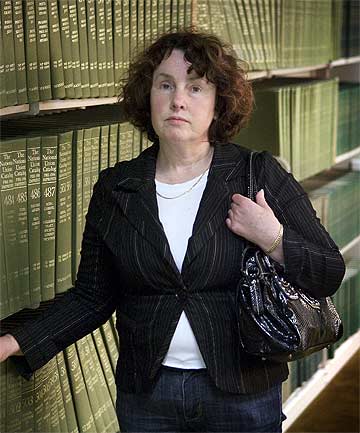
A Pittsburgh disability advocate recalled the case of a 26-year-old mother with multiple sclerosis who was frequently a no-show for doctor's appointments. When she did come, the doctor noted she was dirty and disheveled and admitted she did not take her medications regularly. The advocate, Sherie Lammers (pictured) of the Western Pennsylvania chapter of the National Multiple Sclerosis Society, eventually learned that the woman wasn't refusing to take her meds; rather, the woman's M.S. had progressed rapidly because her meds were being denied to her. (Mrs. Lammers declined to name the woman to protect the family's confidentiality.)
The M.S. patient's mother -- who lived outside Allegheny County -- had reported her concerns about her daughter's safety to police in the small southwestern Pennsylvania town where her daughter lived, but when they arrived at the house to check on the situation, the daughter's husband told officers his wife wasn't home. Grasping for another solution, the woman's mother called child protective services to report that she suspected her daughter's three young children were in danger, and that's when officials had legal grounds to get involved.
Child protective services arrived to find the 5-year-old and toddler twins locked in a room. Child advocates found the M.S. patient thoroughly incapacitated and contacted a women's shelter. Her husband had prevented her from taking her disease modifying medications and was sedating her to the point of unconsciousness, according to the counselor from the shelter. She had gone blind and was unable to walk from not taking medication to prevent the progression of the disease.
The woman slipped into a coma and died. The husband spent four months in jail for endangering their children.
Mrs. Lammers said she also works with a woman in her early 40s in the North Hills whose husband left her at home for up to 11 hours in soiled diapers. She said the husband was left in sole charge of his wife's care after her son went off to college. The husband was embarrassed by his wife's illness and didn't fill her prescriptions on time because he felt her medicines were bankrupting the family.
Her doctor became concerned because she didn't show up for appointments. When she did, she had bedsores. In cases like this, rank-and-file officers or a police detective could have done a welfare check, but couldn't enter the home without probable cause.
Ms. Murray, of ARC, said in the absence of a law, negligent caretakers have been hard to pin down, even in the face of a vocal citizenry: The story that came to mind was that of a young woman who lives in a dilapidated house in the Allentown section of Pittsburgh with various family members.
Neighbors knew she had attended special schools as a child. Over several years, these neighbors reported to Ms. Murray and other officials that they'd seen the woman with an intellectual disability, now in her late 20s or early 30s, walking the streets in unsuitable clothing for winter. She seemed perpetually hungry. Some reported seeing bruises. Neighbors then said they saw her out less and less. They tried to talk to her but she appeared frightened.
"Oftentimes, folks like this young woman are threatened by their family members not to talk to strangers. Either her communication skills are not very good or her family has threatened her, or both," Ms. Murray said.
"The family is basically living off her government benefits."
Social Security does not assign a caseworker; it simply cuts a check, so the agency would not know whether a person is not receiving the money or is hungry. But advocates, concerned family members and neighbors will soon be able to take advantage of the new enforcement powers guaranteed by the Adult Protective Services law.
"If this law were in effect today for this young woman in Allentown," Ms. Murray said, "I or somebody else would call the appropriate authorities and an investigation would be mandatory."
Subscribe to:
Posts (Atom)