We envision a world in which all people are accepted and valued for who and how they are: where all are welcomed with respect and given equal opportunities to contribute to the human experience.
The mission of The ADA Legacy Project is to honor the contributions of people with disabilities and their allies by:
Preservation, celebration, and education: this is how we will honor this historic civil rights legislation and create its legacy: a world in which every citizen is accepted for who they are.
- preserving and promoting the history of the disability rights movement;
- celebrating the impact of the Americans with Disabilities Act (ADA), as well as other related disability rights legislation and accomplishments; and
- educating the public to create opportunities for inclusion, access, and equal rights for the future.
In addition,the National Center for Civil and Human Rights - scheduled to open Memorial Day 2014 in Atlanta, Ga., - will feature exhibits that chronicle the history of the disability rights movement.
The National Center for Civil and Human Rights (NCCHR) is a 42,000 square foot facility in downtown Atlanta, Georgia that plans to open Memorial Day weekend 2014. The Center is dedicated to exploring stories of civil and human rights throughout the world.
In 2012 NCCHR agreed to partner with The ADA Legacy Project to include the story of disability rights history and current issues. Since then, The ADA Legacy Project has worked closely with NCCHR to provide content and advice on exhibits that address disability. The Project is also working with NCCHR to plan for additional exhibits and events in 2015 to correspond with the 25th anniversary of passage of the ADA.
Sunday, November 10, 2013
ADA Legacy Project launches website to prepare for 25th anniversary in 2015
Friday, November 8, 2013
CIDNY applauds court's judgment that NY City needs to address needs of people with disabilities in emergency planning
From CIDNY in NY City. Pictured is a wheelchair ramp to a locked door at a hurricane evacuation shelter. Photo by Susan Dooha, Executive Director of CIDNY.
NEW YORK, NY – Susan Dooha, Executive Director of The Center for Independence of the Disabled, New York (CIDNY), a plaintiff in the case, Nov. 7 issued a statement following the Honorable Judge Jesse Furman’s decision that New York City fails to address the needs of people with disabilities in emergency planning:“We are proud of the Court’s decision in this critical civil rights matter.For over a decade, we have warned the City about its failure to adequately plan for people with disabilities in emergencies. Today’s decision will put the City on the road to ending the needless suffering of New Yorkers with disabilities during disasters.The court clearly concludes that the City failed to provide for high-rise evacuation, accessible transportation, for architecturally and programmatically accessible shelters, canvassing, accessible communications during recovery, outreach and education regarding personal emergency preparedness, and lacks plans for getting people the information they need.Representatives from CIDNY were out the day before and the days after Sandy hit checking on shelters, trying to reach out to people with disabilities in the affected areas and trying to connect people with disabilities with help. CIDNY found shelters with locked doors at ramps, temporary ramps that would be dangerous for people with disabilities; and shelter staff that were not trained or ready to accommodate the needs of people with disabilities – no refrigeration for medications; no way to provide special diet needs and no accessible sleeping cots. In many cases, bathrooms were inaccessible for those who use wheelchairs.We welcome the U.S. Department of Justice as a partner in the remedy phase. We’re ready to continue our work; we hope the City is ready to do the large scale change that needs to be done to plan for all New Yorkers. We look forward to speaking with the incoming Mayoral team about ways to improve compliance with federal civil rights law.CIDNY applauds Judge Furman’s decision and looks forward to working with the city to ensure the safety and security of all New York City’s residents.”About The Center for Independence of the Disabled, New York (CIDNY)The Independence of the Disabled, New York (CIDNY) is the leading voice of people with disabilities in New York City. An independent living center, CIDNY’s goal is to ensure full integration, independence and equal opportunity for all people with disabilities by removing barriers to the social, economic, cultural and civic life of the community. www.cidny.org
Thursday, November 7, 2013
British girl with cerebral palsy lands major modeling gig for Boden brand
From Yahoo! News:
Meet Holly Greenhow (pictured), one of the newest child models for popular British clothing brand Boden. The giggly 7-year-old has golden blond hair and a sunshiney smile. Like many little girls, she loves dressing up. But what's unique about Holly is that she's the company's first model with cerebral palsy, which was caused by prolonged oxygen deprivation at birth.
It was initially Holly's grandmother who suggested that the child's mother, Fiona, take the little girl to a casting call for Boden—one of Holly's favorite clothing brands. "Not many children with disabilities have the opportunities that other children have," Fiona, told ITV News. "I wanted to show that you don't have to be perfect to be in a magazine or online or in photographs, so that was my desire to push forward and get it done for Holly."
It took two years to nab an audition, but this spring, Holly was invited to a casting session and chosen to participate in the latest online catalog. She and her mother traveled from their home in Cambridgeshire to London, where she spent a day trying on clothing and clowning around with the other kids being photographed. Zena Botha, the studio shoot and model manager, told the Daily Mail she was "delighted that Holly made the cut." She added that "Holly was charming and we're very pleased with the shoot."
Holly attends a local elementary school along with her 10-year-old brother, Oliver. She needs a wheelchair to get around, and, while she understands everything said to her, she's just started to be able to speak with an eye-controlled computer — similar to the one used by physicist Stephen Hawking. In a Q&A posted on Boden's blog, the giddy young model said the funniest person she knows is "Mummy," and that if she ruled the world she would play all the time, admitting that the silliest thing she's ever done is take a bath with her clothes on.
As it turns out, Holly isn't the first child with a disability to model for a large company. In 2012, the British brand Marks and Spencer launched the career of 4-year-old Seb White, a boy with Down syndrome, after he appeared in its Christmas ad campaign, and Holly's dad, Paul, said he was hopeful her Boden stint might lead to other opportunities. In the United States, a small handful of television programs such as "Glee" are notable for starring young characters with disabilities, and a 2012 Target catalog featured a boy with Down's Syndrome. But generally speaking, people with disabilities are nearly invisible in mainstream media.According to the U.S. Census Bureau, about 12 percent of Americans are living with disabilities, while the organization Inclusion in the Arts and Media of People With Disabilities reports that less than 1 percent of the regular characters on television are portrayed as having disabilities.
By Geoff Robinson Mark Perriello, the president and CEO of the American Association of People With Disabilities, tells Yahoo Shine that he's pleased that some retailers are finally "starting to take notice of the 1 billion people with disabilities worldwide." He adds that "many people with disabilities face lowered expectations and stigma, and the positive impact of this kind of advertising can't be overstated."While Holly is just one cute and spunky little girl, Boden's choice to feature her, and to do so in a way that Perriello praises as "tasteful and without pity," may help chip away at the prejudice that disabled kids still face every day. "I hope it will help the image of disabled children," said Holly's mother. "And also open people's eyes to the fact there are lots of children out there who aren't perfect."
Review of "Cinemability" in Los Angeles Times
From The LA Times:
When "The Celluloid Closet" debuted in 1996, it became an instant landmark in the fight for gay equality. Rob Epstein and Jeffrey Friedman's documentary presented a mostly dispiriting history of homosexuals on the big screen and concluded that, given the power of cinema in shaping psyches and societies, fairer representations of the gay community were urgently needed.
In "CinemAbility," filmmaker Jenni Gold adopts a similar message and tack on behalf of the physically disabled. Narrated by actress Jane Seymour and packed with A-list interviewees, this exhaustive and eye-opening documentary explores images of the physically disabled on TV and in the movies.
Because cinema's earliest stories about disability now strike us as patently offensive — popular tropes included supposedly handicapped beggars who faked their infirmities and blind girls who miraculously regained their eyesight as a reward for virginal behavior — the film's overall narrative is one of rocky but steady progress.
The film's most interesting segment arrives halfway through, when the talking heads weigh in on the appropriateness of able-bodied actors playing disabled roles. Producer Janis Hirsch compares it to blackface, while director Garry Marshall insists that "it's really about talent and magic" — not accurate representation. The discussion ends without resolution, a sign that the disabled community is quite diverse — and they have a lot of opinions about how they're being portrayed by Hollywood.
"CinemAbility." MPAA rating: PG-13 for some thematic elements and language. Running time: 1 hour, 38 minutes. At Laemmle Town Center 5, Encino.
Friday, November 1, 2013
New York Times does in-depth story on Disability Studies as discipline
From The NY Times. In the picture, April
Coughlin, who has a master’s degree in disability studies, led New York
City Teaching Fellows along the High Line last summer to demonstrate
accessibility issues.
The temporarily able-bodied, or TABs. That’s what disability activists call those who are not physically or mentally impaired. And they like to remind them that disability is a porous state; anyone can enter or leave at any time. Live long enough and you will almost certainly enter it.That foreboding forecast is driving growth in disability studies, a field that didn’t even exist 20 years ago. The reasons are mainly demographic: as the population ages, the number of disabled will grow — by 21 percent between 2007 and 2030, according to the Census Bureau.At the other end of the generational spectrum are those raised after the passage of the Americans With Disabilities Act in 1990. They are now in college or entering the work force. They are educated, perhaps without even realizing it, in the politics and realities of disability, having sat in the same classrooms in a more accessible society.Universities have long studied the disabled in medical and health care curriculums. But when the first disability studies program emerged at Syracuse University in 1994, it was a radical departure from the medical model that had dominated offerings for decades and had approached disability as a deficit that needed fixing.Like black studies, women’s studies and other liberation-movement disciplines, disability studies teaches that it is an unaccepting society that needs normalizing, not the minority group. “Disablement comes from a confluence of social factors that shape one’s identity,” says Tammy Berberi, president of the Society for Disability Studies. “It is not a distinct physical condition or a private struggle.”WHAT YOU’LL STUDYThe Modern Language Association, which promotes the study of literature and the humanities, established disability studies in 2005 as a “division of study.” This says much about how far the field has come in the last 20 years, and about its mission.Through courses in disability history, theory, legislation, policy, ethics and the arts, students are taught to think critically about the “lived lives” of the disabled, and to work to improve quality of life and to advocate for civil rights. “It’s more than teaching the disabled how to make an omelet,” Dr. Berberi says. The emphasis is on applying lessons from the humanities to solving the social struggle at hand.Steven J. Taylor, who created the Syracuse program, puts it succinctly: “Disability studies starts with accepting the disability. Then it asks the question: ‘How do we equalize the playing field?’ ”WHERE YOU CAN STUDYSome 35 colleges and universities tackle that question through graduate and undergraduate degrees, minors and certificates. Not all get to the answer in the same way, or agree on what constitutes a successful endgame. Mariette J. Bates, academic director for the program at the City University of New York School of Professional Studies, says the differences stem from a fragmented field (“cognitive doesn’t talk to physical, and no one talks to mental”) and divergent academic approaches (theoretical versus clinical).CUNY, Syracuse University and the University of Illinois at Chicago have the oldest and best-known programs. A complete, vetted list can be found on the web site for Syracuse’s Center on Human Policy, Law and Disability Studies.Because of its history and student body, CUNY takes the most applied approach. The program grew from a Kennedy Fellows program in special education and rehabilitative counseling, and 70 percent of those seeking a credential there in disability studies work at service agencies. CUNY started a four-course graduate certificate in 2004 and, because of student demand, created a master’s in 2009 and a bachelor’s — the first in the field and completely online — in 2012.Syracuse’s program — an undergraduate minor and an advanced certificate — emerged from its school of education at a time when the university was emphasizing educational mainstreaming and dissolving its special education program. At the graduate school level, candidates from any discipline can enroll in the certificate of advanced study, or combine disability studies with law. The only free-standing Ph.D. is at the University of Illinois’s Chicago campus.WHY STUDY ITThe rationale for the interdisciplinary approach? Jobs. Disability studies has its greatest impact when taken up with another pursuit, academic or professional, Dr. Taylor says. For doctoral students, an interdisciplinary approach increases the odds of landing an academic appointment, since there are few professorships in disability studies alone.Graduates can go on to careers in architecture, management, engineering, policy, law, rehabilitative medicine, music and the arts. The most obvious application is in education and human services, including social work and health care, where advancement often requires certification or a graduate degree.What a credential “signals,” says Noam Ostrander, who has a Ph.D. in disability studies from U.I.C. and is director of the Master of Social Work program at DePaul University, “is a nuanced understanding of disability that is not the tragic, scientific model but a progressive model of disability that is more empowering.”WHO IS STUDYING ITJoseph Plutz, the coordinator of disability services at the Fashion Institute of Technology, began as an administrative assistant 10 years ago. With a background in finance, 15 years in the corporate world and no formal training in education or social services, he was looking to be promoted to a counselor position. His office coordinator suggested CUNY’s certificate, which he earned in 2010. He then continued for a master’s. The degree, he said, positioned him to work directly with students, most with cognitive or learning impairments, advising them on course scheduling, time management and ways to advocate for educational and, eventually, on-the-job needs.The discipline, unsurprisingly, attracts students with disabilities, or those with a disabled loved one. Forty percent of the students in the U.I.C. master’s, minor and certificate programs are disabled; about 60 percent of those enrolled in CUNY’s bachelor’s program have a disability or a disabled child.April Coughlin has been in a wheelchair since a car accident left her a paraplegic at age 6. That didn’t stop her from becoming a triathlete wheelchair racer or a middle and high school English teacher. Her six years working in New York City schools galvanized her. She routinely encountered access issues. She was unable to consider jobs in older school buildings, some of which house the city’s top schools, because they were not wheelchair accessible. If she couldn’t get in to teach in certain schools, she realized, many children with disabilities couldn’t learn in them either, or see a person with a disability leading the classroom.She wove a disability perspective into her literature curriculum, but saw a bigger calling: educating teachers across the board about the needs of students with disabilities. She completed a master’s in disability studies at CUNY in 2011 and is a Ph.D. candidate in special education and disability studies at Syracuse. “Disability studies provided me with the language I needed to describe what I had been going through my whole life,” she says.Her goal is to train future educators at the college level. She already has a start. Last summer she was a trainer for New York City Teaching Fellows. She also teaches an online course in disability and embodiment for CUNY, in which she uses memoir writing, videos and film to convey the experience of being disabled.
The best way to learn is from those who have lived it, she says. “I can’t help but bring my real-world stories to the classroom. I like to think my disability gives me credibility.”
Saturday, October 26, 2013
More U.S. museum programs welcome art lovers with disabilities
From The NY Times. In the picture, Annie Leist, left, a volunteer at Boston’s Museum of Fine Arts, guides Mercedes Austin, 17.
ON a recent Friday night, the Metropolitan Museum of Art in New York held its first public exhibition of original art made in its “Seeing Through Drawing” classes. Participants — all blind or partly sighted — created works inspired by objects in the museum’s collection that were described to them by sighted instructors and that they were also allowed to touch.In another gallery, a tour in American Sign Language was followed by a reception for deaf visitors. And on select Fridays, new “multisensory stations” invite all guests — including those with a range of disabilities — to experience exhibits though scent, touch, music and verbal imaging, or describing things for people with vision impairment.“The Met has a long history of accessibility for people with disabilities,” said Rebecca McGinnis, who oversees access and community programs. As early as 1908, the museum provided a “rolling chair” for people with mobility issues, and in 1913 held talks for blind public school children, she said. Today, there are programs for people with disabilities nearly every day.Such efforts by museums are likely to increase. In 2010, about 56.7 million people, or 18.7 percent of the population, had some level of disability, according to the Census Bureau. And both the number and percentage of disabled Americans are expected to increase in coming years because of the aging of the population, greater longevity and more cases of certain types of learning disabilities, said the Open Doors Organization, a nonprofit group in Chicago serving disabled people.“Museum designers have used a great deal of imagination, much more than is required by law, and do remarkable things,” said Lex Frieden, a professor at the University of Texas Health Science Center in Houston and director of one of the regional centers to help compliance with the Americans with Disabilities Act of 1990.Mr. Frieden, whose spinal cord injury after a traffic crash in 1967 left him a quadriplegic, said museums made commitments to accessibility before the 1990 law and even earlier federal legislation. The Smithsonian Institution has long been a leader in the field; its definitive guidelines to accessible exhibition design are used globally, he said.Early adaptations to overcome barriers to sight were mirrors on ceilings, video screens at varying heights and lowered pedestals and cases “to a sweet spot of visual field” for all users, including wheelchair users, said Beth Ziebarth, director of the Smithsonian’s accessibility program.Innovations continue. A new program allows families with children on the autism spectrum and cognitive disabilities to arrive before opening hours and to receive materials in advance to get familiar with the building and exhibits.In a crowdsourcing effort, the Smithsonian last year began inviting visitors to provide audio descriptions on mobile devices of the nearly 137 million objects in its collection — an example of how measures primarily to help people with disabilities can often benefit the public.Similarly, when the Museum of Fine Arts in Boston opened its Art of the Americas wing a few years ago, it took a universal approach to its mobile multimedia guide. Hannah Goodwin, the manager of accessibility, said if a person with a vision or hearing disability is visiting the museum with a nondisabled friend, “you use the same devices, with access to the same content.”In Manhattan, the Whitney recently introduced vlogs — video tour blogs — whose segments are recorded by deaf hosts in American Sign Language. But since they are also captioned in English, they have become popular even among people without hearing impairments.“It’s a brave new world out there” said Larry Goldberg, director of the National Center for Accessible Media, a research and development department at WGBH in Boston. “There is such a range of new technology, and museums are taking advantage of it.”For example, the Art Institute of Chicago plans to experiment with 3-D printing to reproduce artworks and allow visitors, like those with Alzheimer’s disease, to explore the texture, scale and other sensory elements of objects in ways not otherwise possible.The Guggenheim’s mobile app includes closed-captioning for videos; enlarged-text capability, verbal description tours and advanced screen-reader technology that enables full navigation through touch and voiced description of everything on the screen.Indoor navigational services are coming to museums, Mr. Goldberg said, that are ideal for people with visual impairments. For example, ByteLight software translates location signals from modified LED lights to smartphone apps to help visitors interpret exhibits or navigate within the museum.The Museum of Science in Boston expects to broaden its testing of ByteLight technology in coming months. “For indoor location awareness technology, it is the most promising,” said Marc Check, the museum’s director of information and interactive technology. “Technologies like GPS are effective outside, but much less precise inside.”The museum is also experimenting with interactive touch-screen technology. It has built a large touch table, like a giant iPad, that will give people with visual and fine motor skill limitations access to content by swiping and gesturing. A prototype, Mr. Check said, is expected to be in place at an exhibit in the next few months.
Smaller museums are offering services for the disabled, too. In the summer the Norton Museum of Art in West Palm Beach, Fla., joined with local mental health agencies in a program for adults with mental health or substance abuse issues. The North Carolina Museum of Art in Raleigh recently added nine newly acquired Rodin bronze sculptures to its touch tours. The Samuel P. Harn Museum of Art at the University of Florida conducts off-site programs for residents of nursing homes and retirement centers who can’t visit the museum.For exhibitions and performances at museums and other sites, the Leadership Exchange in Arts and Disability, at the John F. Kennedy Center for the Performing Arts in Washington, D.C., advises on things like assisted-listening systems or how to stage sensory-friendly productions. When Eric Lipp, executive director of Open Doors, wanted to improve accessibility at Chicago cultural institutions through its “Inclusive Arts and Culture Program” several years ago, he turned to the exchange.Since then, the Steppenwolf Theatre Company in Chicago has enhanced its services and outreach. Live audio description and American Sign Language interpretation during performances have improved in quality and are offered at more performances. New services have been introduced, like touch tours that allow blind and low-vision guests to go on stage before shows to become familiar with the space.The Steppenwolf and others “go above and beyond,” said Mr. Lipp, who is partly paralyzed. “And they’ve done it for no other reason except the social benefits.”
App to assist deaf mobile-phone users hits FCC roadblock
From The Washington Post:
It has been nearly two years since Miracom sought Federal Communications Commission approval for an app designed to help the deaf use mobile phones.
The app, known as InnoCaption (pictured), allows deaf users to “hear” a person talking on the end of a call with the help of a stenographer who transcribes the conversation.
But Miracom needs FCC approval to gain access to a government fund that would allow deaf customers to use the app for free.
The FCC, troubled that the $700 million fund has become riddled with fraud, is refusing to grant any new companies access to the fund. In some cases, the agency found, scammers were using phones meant for the deaf to hide their identity. In others, doctors were paid to refer patients to the service — whether they needed it or not.
The fund stands to become heavily burdened as aging baby boomers join the 48 million Americans who have some form of hearing loss. Fraud, therefore, is something agency officials say that they can’t afford.
The FCC declined to comment for this story, but in a January government filing it said that fraud puts the fund “in jeopardy and threatens to deprive people who are deaf or hard of hearing of the benefits of the program.”
Deaf community advocates worry that the FCC’s delays are hindering progress that is critical for those who have trouble hearing as the world increasingly moves to mobile technology. “The more competition you have in the field, the better,” said Lise Hamlin, director of public policy at the Hearing Loss Association of America. “There’s no motivation to get better.”
That’s certainly a worry for Miracom. The company’s investors are growing impatient, and company executives say they are worried that it will have to kill the app.
“The product would go away, the opportunity would go away,” said Chuck Owen, chief operating officer of Miracom. “We do want to provide this service, but not at all costs.”
The Interstate Telecommunications Relay Services Fund’s fraud problems came to light in 2012. The fund pays for technology that allows the deaf to speak to other users through live operators or computer software that transmits their conversations in real time. Miracom, Sprint, AT&T, Purple and other service providers are reimbursed for every minute of a relay call.
As of October 2012, providers logged about 8 million minutes of calls per month.
Some providers have given out special captioned phones for free to those who didn’t need them, according to government filings. Others were paying audiologists who referred patients to the captioned telephone program against suggested guidelines.
The FCC also found that the service was attracting scammers who want to avoid the cost of making a call or disguise their identity. (The transcriptionists at the center of the calls are prohibited from revealing what they hear or alerting authorities if they suspect a crime.)
In May, AT&T paid an $18.3 million fine after the FCC accused the company of failing to adequately verify the identities of those registering for the phones. The registration process, the agency said, made it too easy for foreign scammers to use the phones to buy goods with stolen credit card numbers. In a complaint filed by the Justice Department at the time, the government said the fraudulent calls accounted for up to 95 percent of AT&T’s call volume paid for through the fund.
That type of fraud helped prompt an explosion of demand for the fund, which is supported by fees from approved service providers. This was especially pronounced in the area of Internet-supported services, in which the FCC saw spending on Internet caption services rise from $40 million in the first half of 2012 to $70 million in the second half.
At the current growth rate, the FCC expects the overall fund to reach $1 billion by the middle of 2014.
The FCC has become sensitive to the appearance of fraud in its public programs after it faced scrutiny this year for Lifeline, known as the Obama phone program. It subsidizes phone costs for low-income Americans, but investigators found that it was being used by people who did not qualify.
To keep the telecommunications relay fund from running into similar problems, the FCC has proposed an overhaul in the way the fund is run, including prohibiting service providers from paying doctors who refer patients to the service and requiring customers to provide registration information.
The FCC has proposed new rules to address fraud, but has not scheduled a final vote.
Meanwhile, members of the deaf and hard-of-hearing community have become frustrated with the delays. Technology advances have made instant communication the norm, while they suffer through clunky conversations with captioned land-line phones or inaccurate voice-recognition software.
Miracom says its app would be helpful to people such as Mark Hope, a program manager for the U.S. Navy. He had to evacuate his office at the Washington Navy Yard during last month’s shooting. Hope, who has been mostly deaf since birth, said a captioned mobile phone would have let him communicate more quickly with colleagues and emergency personnel.
Hope told The Washington Post in an e-mail that he would have been able to “call 911 and quickly get proper directions without any mix-up or miscommunication as would otherwise be the case.” Also, he said, he would have been able to better reassure his family that he was unharmed, rather than communicating by text and e-mail, which drained his phone’s battery.
“The one true benefit of InnoCaption is the peace of mind and the reassurance that your communication with loved ones will be easily and quickly accessible,” he said.
As the world becomes more dependent on cellphones, deaf community activists say, technology that allows the deaf and hard of hearing to use mobile devices is becoming critical.
“From my perspective, I don’t know whether InnoCaption is end all and be all, but the concept of a mobile caption system is hugely important,” said Hamlin, of the Hearing Loss Association of America. “You can’t text message a tow company.”
Wednesday, October 23, 2013
Black deaf filmmaker wants to address lack of representation with film & TV projects
From IndieWire:
Ann Marie Bryan (who goes by the nom-de-plume Queen Jade) is the FIRST (her capital letters, not mine) Jamaican-American deaf filmmaker who proudly calls herself “a pioneer in her own right.” And who’s going to argue with that?She has been producing and writing films for over 20 years and her previous feature film, If You Could Hear My Own Tune, was accepted into several film festivals, including 2011’s San Francisco Black Film Festival and Roxbury International Film Festival.As she says, she believes “in social change and social justice and believes in promoting, spreading and increasing awareness about the lack of Deaf African-American actors cast in roles in the mainstream movie industry and in television.”And one major area of concern for her is the huge lack of representation of black deaf culture, adding that the media at large “lacks representation addressing issues regarding diversity, intersectionalities and Deaf People of Color. We all have stories to share, so many!”As the result of that goal, Ms. Bryan has launched an Indiegogo campaign to raise $75,000 to produce four original films she intends to make.The first project, the feature film The Shattered Mind, is now in post-production with the aim of being done in time to submit to the 2014 Tribeca Film Festival and 2015 Cannes Film Festival.She calls Shattered Mind “a psychodrama and surreal story about a hard-of-hearing teenager who juggles family, peer and culture conflicts while in search of her own sexual identity, freedom, and self-realization.”The film’s protagonist, Zhane Rain, is an intense and carefree high school senior with three generations of hearing and deaf family members who unravels family secrets behind the traumatic brain injury that caused her deafness.Ms. Bryan is also currently developing two new TV-oriented pilots for 2014. The first one, The Two Essences, is a contemporary story about a modern-day deaf mother-daughter relationship; a day trader mother, who one day quit her job to go back to school.The other TV pilot is titled Kaomi’s Three Charms, about a New York hard-of-hearing filmmaker who befriends a deaf playwright, an actor and a musician.But Ms. Bryan soldiers on, as she says, “because I am persistent and relentless. I believe in the cause. I am passionate about my films, my community… We are constantly being ignored, being shoved on the sidelines. Marginalized as we call it. I am determined to change that.
Researchers are working hard to harness the hands-free nature of Google Glass to improve the lives of those with disabilities
From USA Today. In the picture, quadriplegic Tammie Lou Van Sant, 52, demonstrates Google Glass at her Santa Cruz, Calif., home.
The "it" in question is Glass, Google's wearable computer that last summer found its way onto the faces of about 8,000 Glass Explorers, people who, like Van Sant, wrote the search engine juggernaut with a compelling reason why they should be among the first in the world to acquire the $1,500 invention.
Although a number of scientists have been toiling in obscurity since the 1970s on glasses that harness computing power, Google was first out of the commercial gate with a lightweight, voice-controlled device that features a small square prism just off the right eye and a touch-sensitive temple. Through voice and touch, Glass can shoot pictures and video, make and receive calls and texts, and access the Web.
Glass has an expected on-sale date sometime in 2014. As a product still in its infancy, it recalls the iPhone's early days as a smartphone with promise and woefully few apps. But while Glass' full potential will be determined down the road, it already has distinguished itself as a potentially life-changing tool for the disabled.
Researchers in a range of disciplines are looking into ways to leverage Glass' inherent advantage over the smartphone — its hands-free nature — to help those who navigate life with compromised mobility, vision and hearing. There's even work being done to assist those with autism, using facial recognition software to help identify the emotions of others.
Perhaps not since the invention of text-to-voice and other speech-recognition software has a tech invention had such potential to help the disabled.
"Glass will be revolutionary for the disabled," says Rosalind Picard, founder of the Affective Computing Research Group at Massachusetts Institute of Technology's Media Lab, whose focus is autism and communication technology.
"With facial analytics, it's possible to, with the subject's approval, have Glass scan a face and put up a green light if the person is intrigued, yellow if they're confused or red if they're bored," she says. Then, chuckling, she adds, "It could even whisper at you during that date, 'Hey, she's losing interest.'"
Picard says speech recognition is getting so good that a deaf person soon could see a real-time transcript of what a friend is saying in Glass' prism. A person with limited vision could take walking directions from Glass through its bone-conducting speaker housed in the right temple.
"One day soon, we'll look at regular glasses the way we now look at old phones," she says. "It will change things so much."
What pleases Mark Perriello is that, thanks to the feedback-intensive Explorers program, Glass is being developed with input from the disabled.
"All too often, technologies are created and then people ask, 'OK, what if people with disabilities need to use it?'" says the CEO of the American Association of People with Disabilities, a Washington, D.C.-based advocacy group founded in the wake of the 1990 Americans with Disabilities Act.
"From taking a picture with ease to helping those with low vision redefine their world," Perriello says, "this has the possibility to level the playing field."
Wearable computers have always been about increased accessibility, says Thad Starner, who has been toting around computerized glasses of his own design since 1993. In 1998, he demonstrated his creations to a pair of Stanford University students named Larry Page and Sergey Brin. Google's co-founders contacted Starner three years ago and made him Glass' lead designer.
"I could cite academic papers for you, but Larry says it best, 'With Glass, we are reducing the time between intention and action,' " Starner says. "Glass keeps you in the flow of what you're doing, and for people with disabilities, that's even more vital. Suddenly someone isolated at home is more fluent with (text) messages than their friends with a mobile phone. It really can change lives."
For many scientists, the thrill is in trying to turn sci-fi dreams into today's reality. But for some, the quest is personal.
Catalin Voss has a cousin with Asperger syndrome, a high-functioning form of autism; that has led the precocious German-born Stanford University sophomore to found Sension, a company whose missions include developing Glass software that turns the expressions of others into on-screen keywords like "happy" and "angry."
"Emotional recognition (software) is still in its early days, at about the state of a 3-year-old, but I still felt passionate about trying to do something meaningful," says Voss, whose software maps 78 points on the face. "From my personal experience, I know that the issues (for my cousin) are recognizing an expression, and then smiling back. Glass is good for the first, and can help with the second."
As a youngster, Kim Xu used to attend Girl Scout meetings at the home of a girl whose brother was deaf. Fast-forward to last year, when the Ph.D. candidate in human-centered computing at Georgia Tech co-created SMARTSign, an app that pushes out short video tutorials on American Sign Language.
"For my Ph.D., we studied how six families with deaf children used the app," which is also available for Android phones, says Xu, who now works for tech consulting firm Tin Man Labs in Huntsville, Ala.
"Seeing them learn at a faster pace was so satisfying. But it was clear that by using (the app with) Glass, people were able to learn at a more constant pace," she says. "With a phone spending so much time in your pocket, you don't really have it out in front of you as much as you think."
Shaun Kane can appreciate the merits of Glass perhaps a bit better than most researchers. His own physical disability limits him to the use of one arm while he works on ways to help the visually impaired through technology.
"One of the most basic challenges for many disabled folks is just getting around every day carrying stuff, getting things out of pockets and things like that," says Kane, assistant professor in the department of information systems at the University of Maryland in Baltimore County. "If I have something in one hand, that's it for me."
Kane has been using Glass daily since August, mostly to snap photos on the go. But he's bullish on the device's potential to vastly improve quality of life for the blind. "Having something on your head that is pointing naturally in the direction you are looking is invaluable," he says.
Jeff Bigham, who conducts research in the same area, agrees. "Imagine this," he says, excitedly. "A blind person with Glass walks by a store and Glass recognizes it and announces what it is. Maybe that person didn't notice that it changed from a restaurant to a dry cleaner, but now he knows. These are things the rest of us take for granted, but for a blind person, it's truly powerful."
Bigham, an assistant professor at the Human-Computer Interaction Institute at Carnegie Mellon University in Pittsburgh, has developed software that in fact can do such things. A video he posted on YouTube shows a blind man wearing glasses walking through a room filled with equipment, and each time a piece comes into Glass' view it describes the apparatus to the wearer.
Glass' other big score comes in a simpler form. Bigham's VizWiz is a smartphone-based project that has seen 5,000 blind users ask more than 70,000 visual questions ranging from "What's this spot on my baby's head?" to "Do I look nice?" — questions and photos that are then sent out to the Web and answered in less than a minute by live respondents working through Amazon Mechanical Turk.
Where smartphone-based VizWiz users have to contend with the inherent hassle of "using a handheld device while blind, Glass offers the chance to provide continuous, hands-free visual assistance," Bigham says.
When Larry Kaplan wrote in to Google's #ifihadglass contest, he wasn't looking to use them himself. Instead, Kaplan, who sells discounted sneakers online, wanted to make Glass available to the ALS patients he has befriended as a local volunteer over the past 15 years.
"When you have ALS (also known as Lou Gehrig's disease, which cripples motor functions) you often don't feel like a part of full society, and I thought maybe wearing Glass could help," says Kaplan of West Chester, Pa. "It's been amazing. Some patients have no use of their hands, and others are losing their vocal abilities. But they talk to Glass and it understands them."
One of the beneficiaries of Kaplan's gesture is Gary Beech, a retired IRS tax examiner from Philadelphia. "It's very comforting to know that people in my position can still experience some things they might not be able to in life," Beech writes in an e-mail. "Glass can be worn by somebody outside watching a soccer game, and I can watch it all happen at home on a computer. Truly amazing."
One blind Glass Explorer says the potential for greatness lies just beyond the product's initial limitations.
"I'm a little frustrated with (Glass), not because it's something I can't use, but because with trivial modifications I would use it all the time," says Sina Bahram, founder of disability-focused Prime Access Consulting in Cary, N.C., and a Ph.D. candidate in computer science at North Carolina State University. "It's not pie in the sky. For me, Glass could be an amazing conduit to the outside world."
Among his complaints are a volume control that is "embedded too far deep in the menu," a hypersensitive temple touch pad and a "ban on facial recognition (out of privacy concerns) that really hurts those of us who are blind."
Bahram is at least hoping for object recognition to become a reality. "Think about what it's like for me to hail a cab," he says. "Now, picture me wearing a device that sees a cab heading my way, and alerts me to it. That's a paradigm shift."
For Columbia University law school student Alex Blaszczuk, Glass didn't need to deliver a seismic boost but rather just lift her occasionally sagging spirits.
Two years ago, she was on the verge of graduating with her law degree when an oncoming car hit hers while she was traveling in Vermont, leaving her paralyzed from the chest down. With great effort, she has returned to Columbia, where she uses Glass to help her research and communicate with friends and social networking circles.
"My life now is about learning to accept that some things are not available to me," says Blaszczuk, 26, a Chicago native who is fluent in Polish and focusing on international transactional law. "But when I took my first picture with Glass, I smiled and thought, 'That's one less thing I have to be OK with not being able to do.'"
She says an eventual improvement in voice-command technology should make using a device such as Glass even more beneficial, cutting valuable and frustrating time off chores that the non-disabled take for granted, whether answering an e-mail or responding to a text message.
But in the end, the biggest gift Glass gives her is that of feeling normal.
"People with disabilities often are seen either as tragedies or heroes," she says. "But when I'm using Glass, I'm just like anyone else. I can post a stupid cat picture or a shot from a tour of Brooklyn that I took. That kind of self-expression means I'm not limited to being a stereotype."
Santa Cruz's Van Sant is all about self-expression this time of year. Her modest home that she shares with her mother is overrun with Halloween decorations, including three fake graves on her front lawn and a skeleton that writhes in electrocuted pain as you make your way up her wheelchair ramp.
Inside, there's more of the same festive ghoulishness, along with an overly friendly Labrador service dog named Robby who can open doors and windows but is far more interested in being caressed.
Van Sant takes Glass off only to sleep, preferring to have her device handy for that unexpected amazing-pets video or perhaps a breathtaking sunset. The device may seem like a wacky cyborg-like gadget to many on this planet, but for this woman, it has brought a sense of joy that was long banished after a truck hydroplaned, flipped and crashed into her car on a rural highway south of here.
"I'm out more doing stuff since I got Glass, interacting with people and the world," she says. "Sure, sometimes people see me talking to Glass and assume I'm weird. But most times they come up and go, 'Oh, I've heard of those, can I see them?' "
Robby suddenly bounds out of his dog bed over to a visitor with puppy energy; Van Sant apologizes and asks the dog to lie down.
"I waited almost 20 years to be able to take a picture," she says softly, shaking her head in quiet amazement. "I simply can't imagine anything more useful to me."
Robby stands up again. Van Sant sighs.
"Well, other than an invention that would make my dog mind me," she says, laughing. Then, smiling at a contrite Robby, she commands: "Glass … take a picture."
Saturday, October 19, 2013
Fake disabled character karma - NBC cancels 'Ironside' reboot after just 3 episodes
From Indie Wire:
Shocked? Not me. Not at all. And if you read my thoughts on the premiere episode, and those after, you really shouldn't be shocked either.
The series just hasn't been quite the draw that NBC likely hoped it would be.
The debut of Ironside drew decent numbers - 6.8 million viewers and a 1.4 rating (adults 18-49) - thanks in part to the series that leads into it, Law & Order: SVU.
Ironside retained 99.7% of the total-viewer lead-in from SVU, during its season debut night.
That retention didn't quite continue in successive weeks, however, as the most recent episode, which aired on Wednesday, drew 4.8 million viewers and a 1.0 rating. Those aren't necessarily terrible numbers... if you're a cable TV network, that is. But when you're NBC, and you're in a distant 3rd place behind CBS (9.45 million) and ABC (5.76 million) during the Wednesday 10pm hour (when Ironside airs), it's just not a good look.
Repeating what I've said previously, this is a new series that I didn't think would last more than 1 season, and expected that it might not even last through the whole first season, given how anxious networks have become when new shows aren't performing as strongly as hoped for - especially when compared to the competition - and how quick they are to cancel said shows.
Having watched all 3 episodes that did air, from my POV, there's really nothing all-that special about this Ironside reboot that makes it stand out from all the other cop shows on TV currently, and in recent years - other than the fact that the title character is black, as played by Blair Underwood. And that's just not quite enough, when you consider that it seems to be going for something far more gritty, rough and tumble, compared to the 1960s original that starred Raymond Burr, which it doesn't really succeed at, in a cop/detective/crime-solving TV series climate that includes much darker, more graphic, moodier material in the likes of Law & Order: SVU, the CSI franchise, and others.
NBC has unfortunately struck out in the new series department with black leads, over the last 3 or so seasons - remember Undercovers 3 years ago; Deception last season, and now we have Ironside.Underwood did co-star in another NBC series that was canceled after its first season - remember The Event? Just like that action-adventure series, Ironside is now history.Via press release, NBC has announced it will debut Dick Wolf’s Chicago P.D. (the spin-off of Chicago Fire) in Ironside's timeslot - at 10 pm on Wednesdays, starting on January 8.
In the meantime, over the next 2 months, replacing Ironside in that 10pm slot, for November and December, NBC will air a string of original programming, including new episodes of Dateline, Saturday Night Live holiday-themed specials, as well as holiday music specials starring Kelly Clarkson and Michael Buble.
Chicago P.D. will star Jason Beghe, Jon Seda, and Sophia Bush as Windy City cops. The show is a spinoff of NBC’s popular Tuesday night drama Chicago Fire, which continues to see significant ratings increases in its second season.
Blair Underwood's NBC reboot of 1960s/1970s crime drama series Ironside, co-starred, alongside Underwood, Spencer Grammer, Brent Sexton, Pablo Schreiber, Neal Bledsoe, and Kenneth Choi.The series is written and exec produced by Michael Caleo (Rescue Me, The Sopranos), and exec produced by David Semel, Teri Weinberg, John Davis, and Jon Fox.
It's worth noting that, a year ago, Underwood signed what was then referred to as "a major development/talent holding deal" with NBC/Universal TV.
So expect that, under the above agreement, both sides will make another attempt, with another series, starring Underwood.
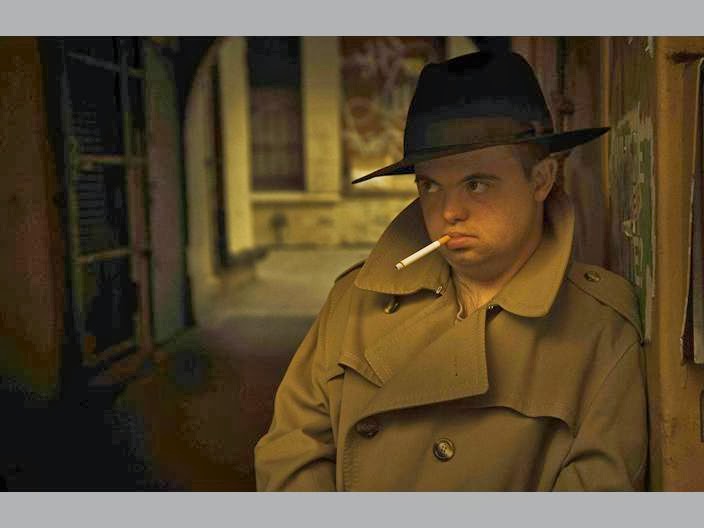
Preview: Norwegian actor with Down syndrome plays 'Detective Downs'
From Digital Journal:
Norwegian Director BÃ¥rd Breien has made a film about a private detective with Down's Syndrome. Svein André Hofsø, the film's star, suffers from the condition and has recently won an award for his acting efforts.In the official trailer (in the link above with English sub-titles) we see Hofsø, dressed as all private eyes should be, in a trench coat, with a hat cocked over his eye and an enigmatic cigarette drooping from his lips.However, this is a different private detective — one that suffers from Down's Syndrome. Hofsø himself suffers from the condition, and plays the part perfectly.However, despite having the perfect appearance as a private eye, he lacks any cases, and a lady decides to help him in his quest. And what makes him different is the fact that he uses empathy to solve his cases.Jon Sopel of the BBC asked director BÃ¥rd Breien how he got the idea for the film, which has caused huge interest abroad. Breien said:I was fed up with the usual detective routine. I said if I'm ever going to make a film about a detective, he's going to have Down's Syndrome.The leading actor, 33-year-old Hofsø, had previously appeared in an amateur film made by his brother and sister and enjoyed acting. He then spent a year preparing for the part in Detective Downs, and his excellent performance has challenged viewers' assumptions about what Down's Syndrome people are actually capable of. Hofsø won an award for best actor in September at the Fantastic Fest film festival in Texas and says that if the film is a success, he may consider a film career."We have no plans to make number two yet, but it is a good idea. If this film is going to be success, maybe," he said. Breien said:"A lot of people told me that it might end up on the bad taste side of it. It was a struggle to make him act so well that he became a beautiful main film character.The film will premiere in Norway in November 2013.
\
Modeling dream comes true for Karrie Brown, teen with Down syndrome
From ABC News:
Karrie Brown has all the makings of a model: energy, enthusiasm and a smile that could melt stains off your sleeves.But it wasn't just those qualities that won the 17-year-old with Down syndrome a modeling gig with girls' fashion label Wet Seal. It was actually Karrie's mother, Sue, who posted photos of her daughter wearing the label's Plus line on a Facebook page she set up that helped make Karrie's modeling dream come true.Every day Sue would post a picture of Karrie in her favorite Wet Seal outfits -- pieces that Karrie said make her "fit in while standing out" -- hoping that they would attract the company's eye.It wasn't long before they did. The company first noticed the Facebook page after receiving a handful of requests via social media telling them about Karrie's desire to model for the company."She immediately caught our attention," Wet Seal's Yasmin Ezaby told ABC News. "We then asked our fans to get Karrie's Facebook page to 10k likes and we would give her the trip of a lifetime. She exceeded this goal in two days."In fact, as of Saturday, the page is now up to nearly double that number of "likes."Wet Seal honored its pledge and flew Karrie and Sue on an all-expenses paid trip from their home in Collinsville, Ill., to Los Angeles, throwing in a trip to Disneyland along the way.Although Wet Seal runs an annual model search competition, it was the first time the company had done a special challenge focused on one individual.Throughout the shoot on Aug. 30, Karrie was "full of energy," Ezaby said."She asked for Justin Bieber so she could sing and dance while shooting," she said. "It was loads of fun. She was a natural in front of the camera."It came as a wonderful shock to Karrie's mother."She was really excited," Sue Brown said. "She was excited about getting her picture taken at Wet Seal and really excited about Disneyland but I think one of the most exciting things for her was getting to see her sister in LA, too."She was so funny during the photo shoot because she said, 'Can I have a little Justin Bieber music please?' and they played it and she started dancing and laughing," she said. "Everyone said, 'How did she learn to move like that?'"Sue is now helping her daughter reach her new goal: to dance on television with Ellen DeGeneres.
Karrie's special photo shoot is set to be released on Wet Seal's website and social channels in the coming weeks.
Subscribe to:
Posts (Atom)